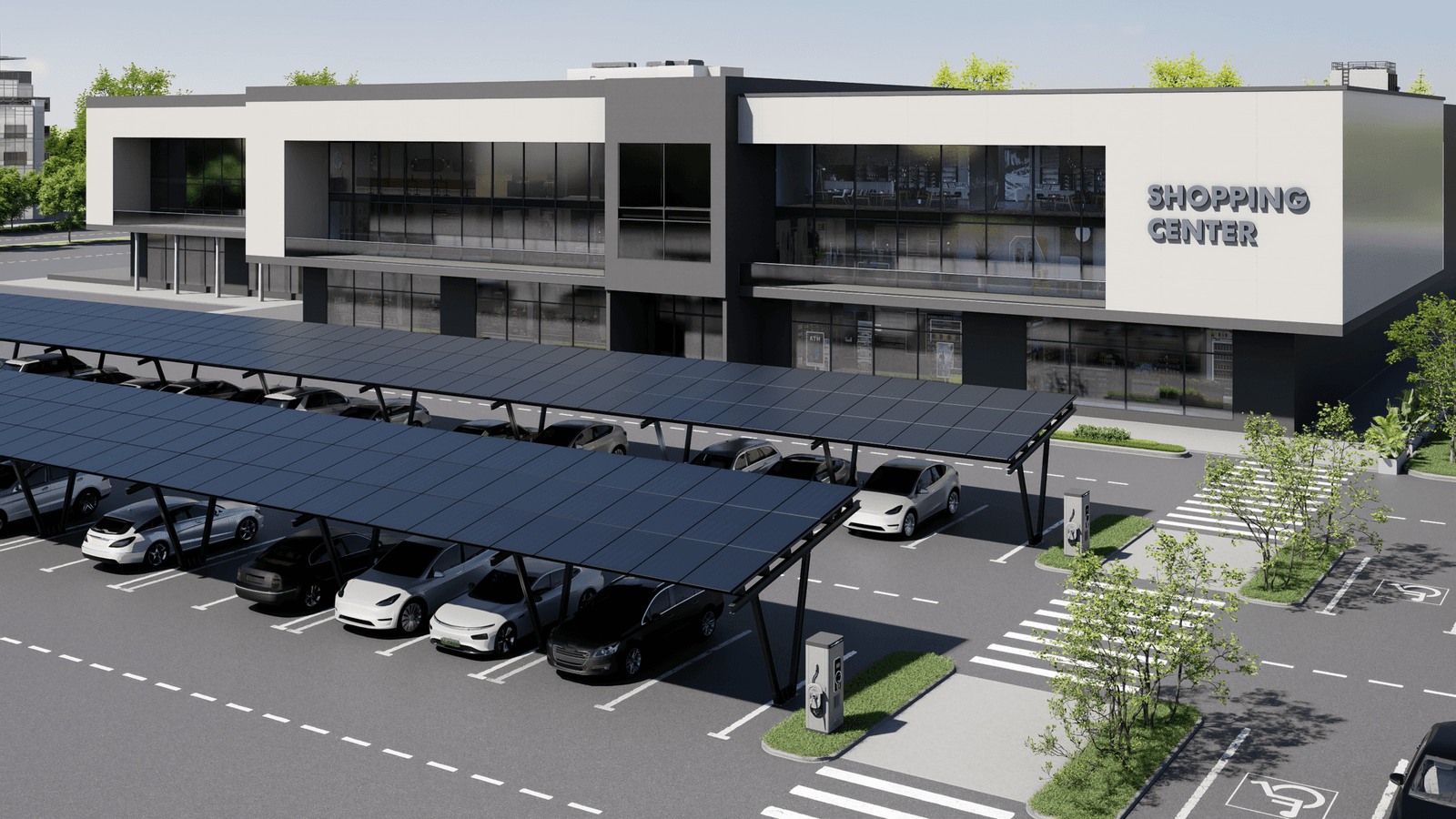
Turn your parking area into an energy-generating asset with customized solar carport solutions from Tay Machinery.
As businesses worldwide seek to reduce operating costs, improve energy efficiency, and adopt more sustainable practices, commercial solar carports are becoming an increasingly attractive infrastructure solution.
Unlike conventional parking shelters, solar carports combine vehicle protection with photovoltaic (PV) technology, allowing businesses to generate electricity while making productive use of existing parking areas.
From shopping centers and office complexes to factories, airports, hotels, and industrial facilities, solar carports offer a practical way to integrate renewable energy into everyday operations.
At Tay Machinery, we provide customized design and engineering services and coordinate manufacturing through qualified partners to develop solar carport structures tailored to each project’s requirements.
Here are seven important benefits of investing in commercial solar carports.
1. Reduce Electricity Costs Through Solar Energy
Electricity is a significant operating expense for many commercial and industrial facilities. Solar carports allow businesses to generate electricity on-site, potentially reducing the amount of power they need to purchase from the grid.
The electricity produced can support a variety of applications, including office buildings, warehouses, manufacturing equipment, lighting systems, and electric vehicle charging stations.
The financial benefits depend on factors such as the installed solar capacity, local electricity tariffs, sunlight availability, system efficiency, and the proportion of generated electricity consumed on-site.
For businesses with extensive parking areas and substantial daytime electricity demand, solar carports can become a valuable component of a broader energy strategy.
2. Protect Vehicles from Sun, Rain, and Weather
In addition to generating electricity, solar carports provide covered parking for employees, customers, visitors, and commercial fleets.
Depending on the design and local weather conditions, these structures can help protect vehicles from direct sunlight, ultraviolet exposure, rain, and other environmental elements.
Shaded parking can also improve comfort for drivers and passengers, particularly in regions with high temperatures.
For businesses operating large parking facilities, this additional functionality makes solar carports more than an energy installation. They become a practical improvement to the property’s infrastructure and user experience.
3. Make Better Use of Existing Parking Areas
Commercial properties often have extensive paved parking areas that serve a necessary operational purpose but provide little additional value.
Installing solar panels above these spaces creates a dual-purpose asset: the parking area continues to accommodate vehicles while the overhead structure generates electricity.
This approach can be particularly useful when rooftop installations are unsuitable because of limited roof space, structural restrictions, shading, or competing uses for the roof.
Potential applications include:
- Shopping malls and supermarkets
- Factories and industrial parks
- Office buildings and corporate campuses
- Airports and transportation facilities
- Hotels and resorts
- Warehouses and logistics centers
- Mining facilities and fleet parking areas
By integrating solar generation into existing infrastructure, businesses can expand their renewable energy capacity without necessarily allocating additional ground space to a conventional solar farm.
4. Support Sustainability and Reduce Carbon Emissions
Commercial solar carports can contribute to corporate sustainability objectives by generating electricity from a renewable source.
When solar generation replaces electricity that would otherwise come from a more carbon-intensive grid, it can help reduce the associated greenhouse gas emissions.
For organizations with environmental, social, and governance (ESG) commitments, solar carports provide a visible way to demonstrate investment in renewable energy and more efficient infrastructure.
They can also support broader sustainability initiatives involving energy management, electric mobility, and the modernization of commercial facilities.
Actual environmental benefits depend on the electricity source being displaced, the system’s lifetime performance, and the materials and construction processes involved.
5. Improve Energy Resilience and Control
Generating electricity on-site can give businesses greater control over part of their energy supply and reduce their exposure to grid electricity price fluctuations.
Solar carports can also be designed as part of a larger energy system incorporating battery energy storage, energy management equipment, and electric vehicle charging infrastructure.
Where technically and economically appropriate, battery storage can help businesses use more of their solar generation outside peak production hours.
However, a standard grid-connected solar carport does not automatically provide backup power during a blackout. Backup capability requires compatible electrical equipment, suitable system configuration, and any necessary storage.
For energy-intensive operations, these considerations should be evaluated during the project planning and engineering stages.
6. Integrate Electric Vehicle Charging Infrastructure
As electric vehicles become more common in commercial fleets and private transportation, businesses are increasingly considering charging infrastructure as part of their parking facilities.
Solar carports provide a convenient platform for combining covered parking, solar electricity generation, and EV charging stations.
Depending on project requirements, a customized system can incorporate:
- EV charging stations for employees and visitors
- Charging facilities for commercial and corporate fleets
- Electrical distribution and cable management
- Battery energy storage integration
- Provisions for future expansion of charging capacity
This integrated approach can help businesses prepare their parking facilities for changing transportation requirements while making productive use of the electricity generated by their solar installations.
The charging capacity and system configuration should be determined according to vehicle demand, electrical infrastructure, available solar generation, and local grid requirements.
7. Customize the Structure to Your Project Requirements
Every commercial parking facility has different requirements. Parking layouts, vehicle dimensions, site conditions, local weather, structural regulations, and energy objectives all influence the design of a solar carport.
A customized solution allows the structure to be developed around these specific conditions rather than relying on a standard configuration that may not suit the site.
Depending on the project, customization may include:
- Single-row or double-row parking configurations
- Different structural spans and clearance heights
- Steel structure specifications and protective finishes
- Solar panel layout and installation arrangements
- Drainage and rainwater management provisions
- Integration with EV charging and electrical systems
- Structural engineering for local wind, snow, and seismic loads
- Provisions for future extensions or additional equipment
Careful design and engineering help align the structure with the project’s functional, technical, and commercial requirements.
For international projects, the design must also account for applicable building codes, structural standards, corrosion conditions, and permitting requirements in the destination country.
Customized Solar Carport Solutions from Tay Machinery
At Tay Machinery, we understand that commercial solar carports are not simply steel structures with solar panels installed above them. They are integrated infrastructure solutions that must meet the specific needs of each project.
We provide design and engineering services and coordinate manufacturing through qualified manufacturing partners, helping clients develop customized solutions for commercial, industrial, and infrastructure applications.
Our project-oriented approach can support:
Design and Engineering: Customized structural concepts and engineering coordination based on site conditions, parking layouts, technical specifications, and project requirements.
Manufacturing Coordination: Coordination with qualified manufacturing partners to produce structures according to the agreed design, specifications, and quality requirements.
Project-Specific Configuration: Solutions adapted to different parking capacities, structural arrangements, solar panel layouts, and potential EV charging integration.
International Project Support: Coordination of sourcing and manufacturing requirements for projects in different markets, subject to applicable technical standards and project scope.
Whether you are developing a new commercial facility, upgrading an industrial site, or planning a large parking installation, Tay Machinery can help you explore a solar carport solution tailored to your requirements.
Start Planning Your Solar Carport Project
Commercial solar carports offer an opportunity to combine renewable electricity generation, vehicle protection, efficient land use, and modern infrastructure in a single installation.
The right solution begins with understanding your site, electricity demand, parking requirements, budget, and long-term objectives.
Looking for a customized solar carport solution for your next project?
Contact Tay Machinery to discuss your requirements.
Email: sales@taymachinery.com
Tay Machinery — One Supplier for Your Needs.